
One source of truth: why your CRM, billing, and reports never agree
It shows up in the Monday meeting. Sales reads pipeline from the CRM. Finance reads revenue from the billing system. The board deck says something slightly different from both, because it was built from an export two Fridays ago. Twenty minutes go to deciding whose number is right, and the actual decision gets ten.
If that scene is familiar, you do not have a reporting problem. You have a truth problem.
How three versions of the truth happen
Nobody plans this. It accumulates.
- Every system is right about its own job. The CRM is the truth about deals. Billing is the truth about invoices. Support is the truth about tickets. None of them is the truth about the customer.
- Integrations sync fields, not meaning. An amount copied from CRM to billing does not carry its definition with it. Discounts, credits, renewal terms, and refunds all drift in the gaps.
- Definitions live in people’s heads. What counts as an active customer? When exactly is a deal won? Ask three departments and collect three answers, each defensible, each different.
- Exports fork the data. Every spreadsheet pulled for a meeting becomes its own aging copy of reality, edited by hand and quoted for months.
What it actually costs
The visible cost is reconciliation: hours every week spent making numbers agree that should never have diverged. The quieter costs are worse. Forecasts get discounted because nobody fully trusts the inputs. Decisions wait on somebody pulling a fresh export, or worse, they do not wait and run on the stale one. And when an audit, a lender, or a diligence process asks for the number, a one-line question turns into a two-week project.
The fix is a layer, not another tool
You do not fix this by buying a fourth system that promises to be the truth. You fix it with a data layer that sits underneath all of them:
- Write the definitions down once. Revenue, active customer, churn, pipeline stage. Agreed by the owners, versioned, and boring on purpose.
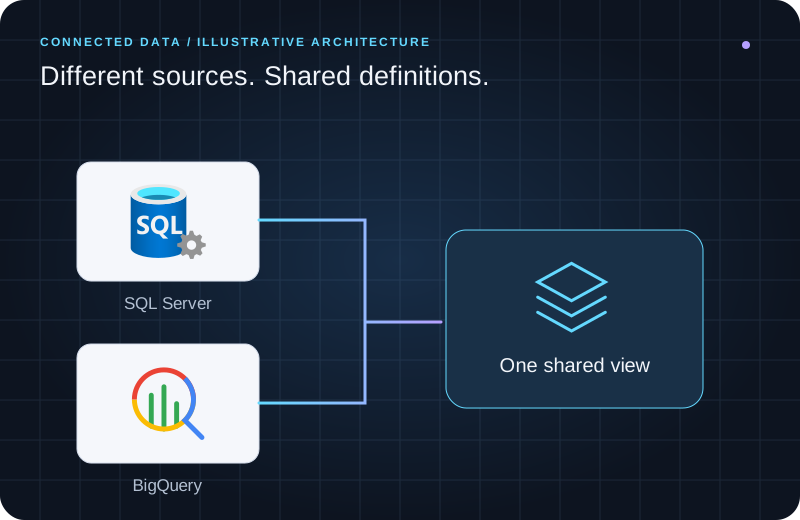
- Pipe every system into one warehouse. SQL Server or BigQuery, fed by pipelines that run on a schedule, not by someone remembering to export.
- Reconcile and deduplicate in the layer. Matching rules decide which record wins, and the decision is logged instead of argued.
- Point every report at the layer. Dashboards, board decks, and forecasts all read from the same tables. Different views, same truth.
How you know it is working
Two tests. First, any number in the leadership deck can be traced to the query that produced it, by someone who is not an engineer, in under a minute. Second, the whose-number-is-right meeting stops happening, because there is nothing left to argue about.
This is the core of our SQL Server and data engineering work, and it is usually the unglamorous project that makes every automation and dashboard after it possible. If your systems each hold a different version of the truth, book a strategy call and we will map the layer that ends the argument.